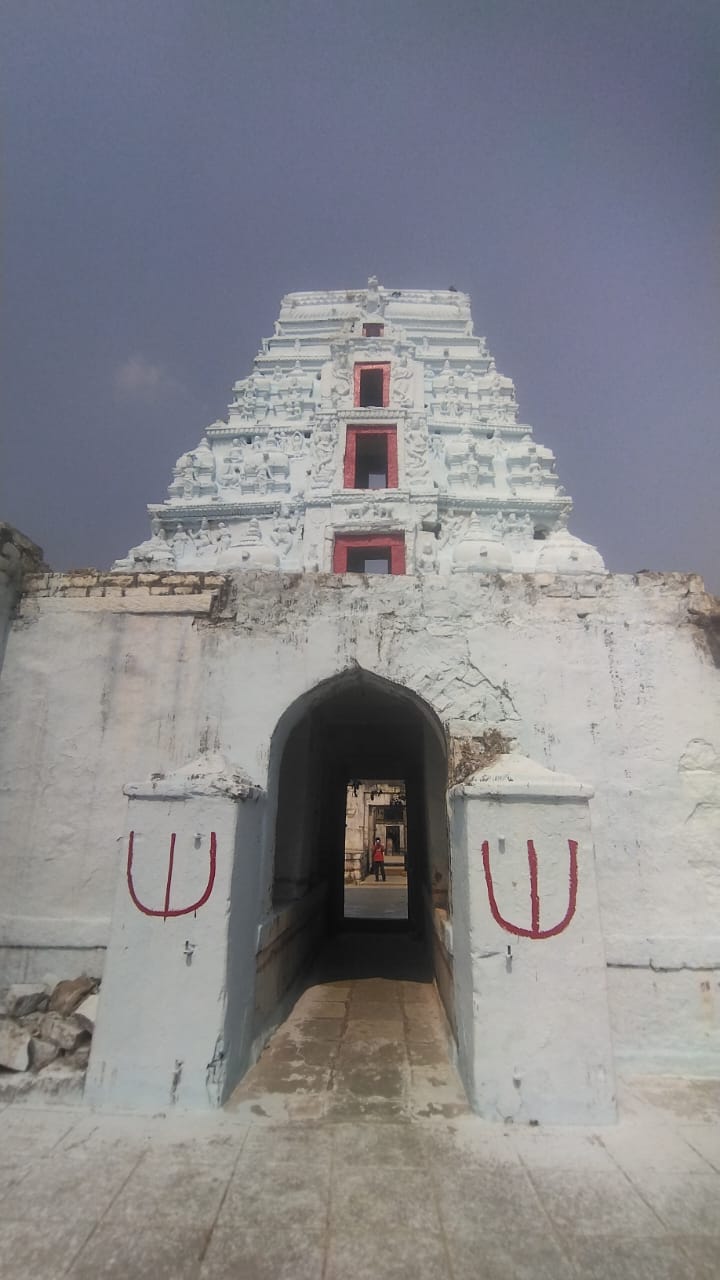
 Entrance
Entrance Gopuram
The old whitewashed gopuram rises above the archway, its tiers crowded with stucco figures. The two pillars flanking the passage carry the red Vaishnava namam.

Stone, proportion and ritual — how the temple at Kodakanchi is built, and what each part of it means.
In the agamic tradition a temple is conceived as the body of the Lord: the sanctum is the head, the mandapams the limbs, and the flagstaff the very breath of the kshetram. Every measurement at Kodakanchi follows that understanding.
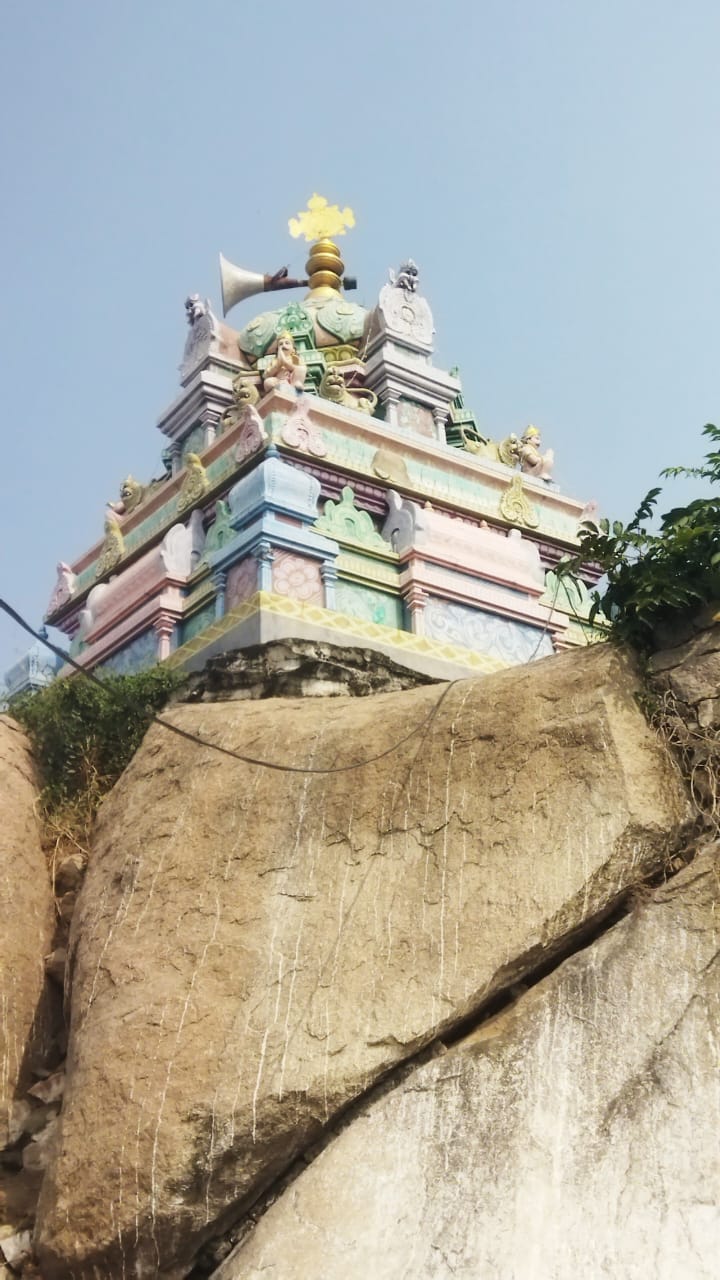
The garbhagriha of this temple stands on a granite outcrop above the village — the very hill on which the swayambhu murti rose of its own accord a thousand years ago.
The brightly painted vimanam rises directly out of the boulders, crowned by its kalasham and the Vaishnava chakra. Beneath it, in the chamber, the Lord is worshipped as Sridevi Bhudevi sameta Sri Adinarayana Swamy — Adi Narayana with his two consorts.
The idol of Garuda — the eagle-vahana of Sri Maha Vishnu — stands on the ground floor of the temple, hands folded in anjali mudra before the Lord.
Vaishnava agama requires that Garuda face the Lord along the temple's central axis. Devotees traditionally offer their namaskaram to Garuda first, and it is he who is said to carry the prayers of the faithful into the sanctum above.
During Brahmotsavam the Garuda Seva — when the Lord is taken in procession on the Garuda Vahana — is among the most attended evenings of the ten days.
Each structure within the prakaram serves a defined role in worship.
Entrance
The old whitewashed gopuram rises above the archway, its tiers crowded with stucco figures. The two pillars flanking the passage carry the red Vaishnava namam.
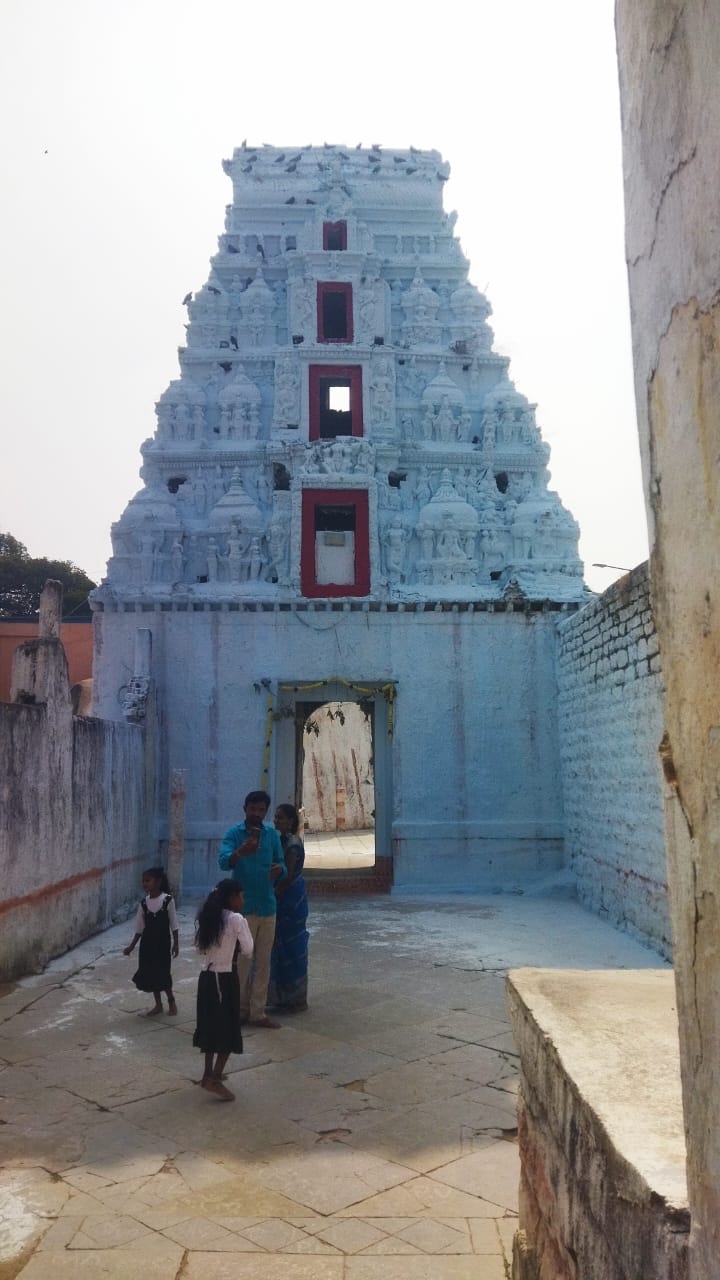
Axis
A second tiered gopuram stands within the enclosure, its red-framed openings set into pale blue-washed stucco. Devotees pass beneath it on the way to the sanctum.
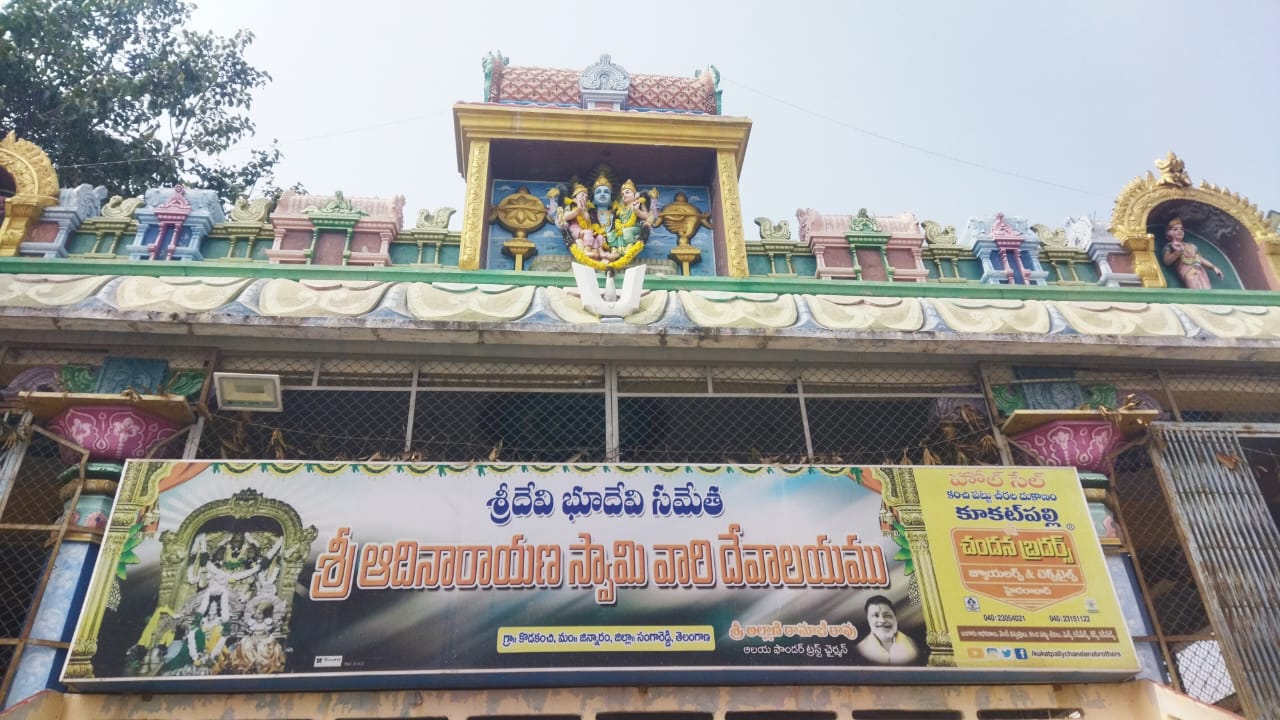 Dwaram
Above the entrance, set in a painted niche, the Lord stands with Sridevi and Bhudevi, the Vaishnava namam beneath them — the first darshan a devotee receives on arriving.
Sanctum
The painted vimanam over the sanctum rises straight out of the granite boulders, its kalasham and chakra catching the light above the rock.
Prakaram
A wide stone-paved courtyard within the enclosing wall, where devotees gather for darshan and complete their pradakshina.
 Water
Water
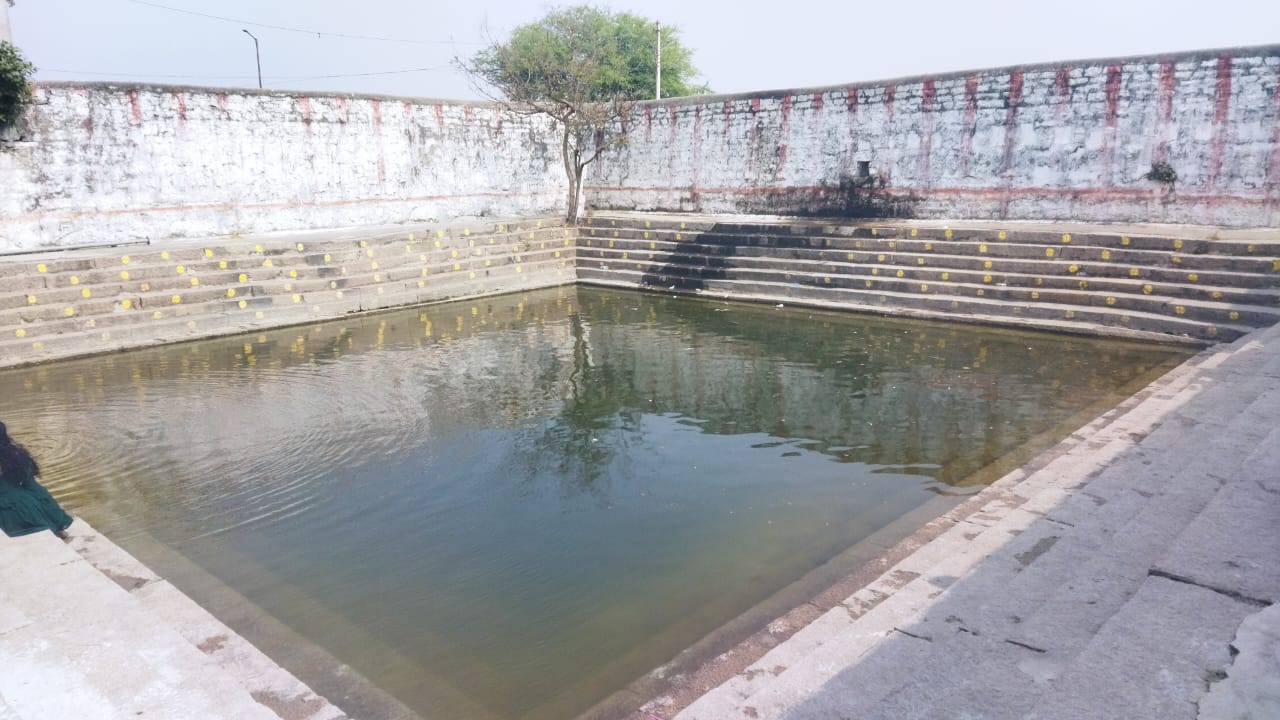
The stepped temple tank beside the shrine, its ghats descending on all four sides. Devotees use it for ritual purification, and it holds water through the year.
The single feature that makes Kodakanchi Telangana Kanchi is set upon the temple wall: a golden lizard and a silver lizard, exactly as at the Varadaraja Perumal temple in Kanchipuram.
Devotees believe that touching them frees a person from lizard-dosha and from the troubles that follow it. It is for this darshan above all that pilgrims who cannot travel to Kanchipuram make the journey here instead.
Outside the main enclosure, beneath a neem tree, stand a Shiva linga with Nandi before it and a shrine to Hanuman — so that the devotee's circuit of the kshetram is complete.
A huge peepal tree shades the temple grounds, and a lake lies beside the surrounding fields — the reason devotees describe this as one of the most peaceful kshetrams near Hyderabad.
The practices that give the temple its character, followed in the same order each day.
Suprabhatam at opening, followed by Abhishekam with panchamrutam and water, alankaram, naivedyam and the morning deeparadhana. The sequence is repeated in shorter form in the evening, closing with Ekanta Seva.
Tulasi leaves are offered to the Lord with the recitation of his names. Tulasi grown in the temple garden is used, and devotees receive it as prasadam.
During Brahmotsavam the utsava murti is carried in procession on different vahanas each day — Hamsa, Simha, Garuda, Hanumantha, Gaja and the Ratham among them.
Feeding devotees is treated as worship in itself. Annadanam is served on festival days and is sustained entirely by devotee contributions.
The periodic re-consecration of the temple, performed after major renovation, in which the kalasham and the murtis are ritually renewed.
Restoration at Kodakanchi uses traditional stone, lime mortar and craftsmanship rather than modern cement wherever possible, so that repairs remain faithful to the original construction. Devotees with expertise in heritage conservation are welcome to offer their guidance.
Offer Your HelpPhotographs convey only a part of it. Come for a morning darshan and walk the prakaram in the quiet before the day begins.